
Although irregularities in the network are rather rare, they occur more frequently than is commonly assumed. Without Uninterruptible power supply (UPS) hardware and software can be damaged. There is a risk of expensive IT failures, which in turn can lead to lost sales and, in the worst case, to the loss of the customer. The reliability of a data center therefore starts with a reliable, uninterruptible power supply.
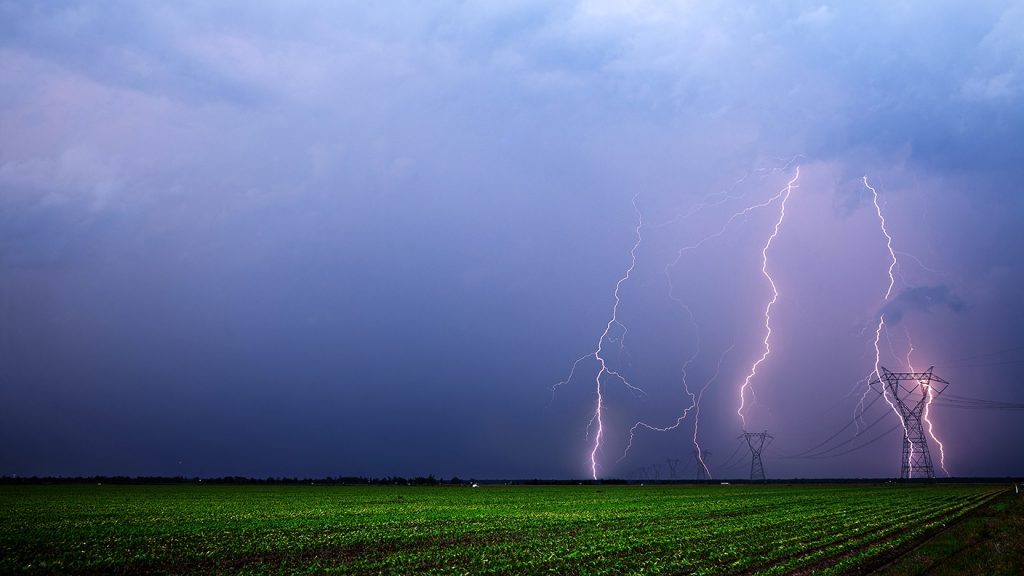
So how do data centers protect themselves from unforeseen power outages or grid fluctuations?
Outages in our power grids are on the rise. Causes can be overload (e.g., due to excess capacity from renewable energy plants or lightning strikes), outdated infrastructure, vandalism, or cyber attacks. Data centers are dependent on electricity. Even simple voltage fluctuations or short outages in the power grid are enough to potentially damage hardware and software or disrupt them in such a way that far-reaching errors occur in IT processes.
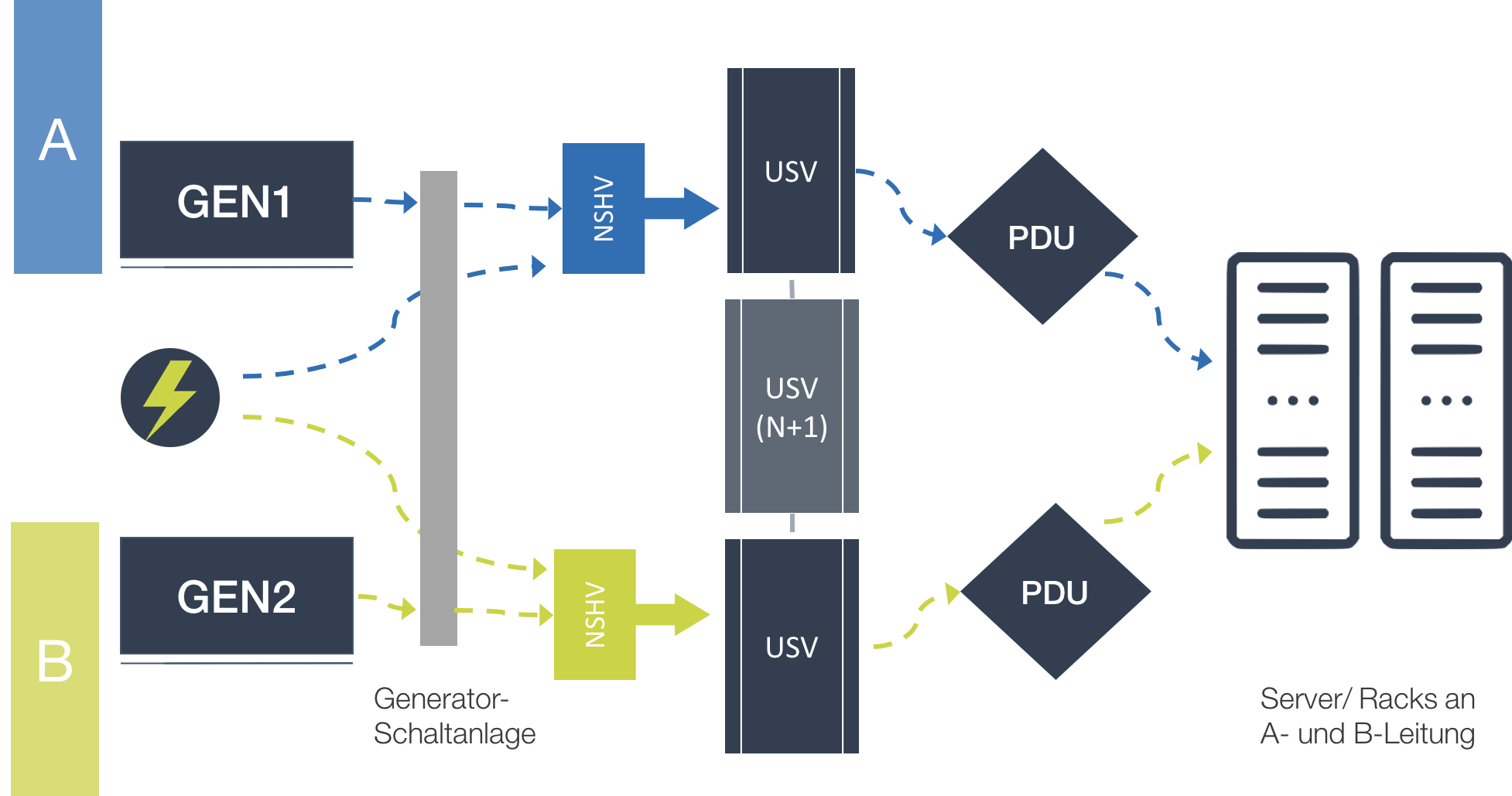
To ensure maximum power supply and thus availability of the data center, an efficient, multi-redundant power distribution network is created. An essential component is the uninterrupted power supply (UPS). The UPS is connected between the public AC network and mission-critical loads in subdistribution units of the data center in order to intervene in the event of power failures and fluctuations in supply power. With the help of its integrated battery system, the UPS can bridge disturbances in the power supply.
In a Tier III Data Center become All supply-critical components - UPS, generator, distribution network and cooling systems - redundant over a continuous dual distribution network (A and B supply), in a so-called. parallel-redundant system ("N+1"), provided.
In the event of a disruption of the main supply pathway due to:
- Power failure of the public utility
- a malfunction of a low-voltage main distribution board (LVMD).
- of the technical supply,
the UPS can bridge the power supply for at least 15 minutes at maximum load because the failed load is automatically distributed to the remaining UPS modules. The operation of the systems continues without interruption until the emergency generators (also known as the emergency power system, or "NEA" for short) take over the supply. The NEA is controlled automatically. In the event of a failure, the respective generator starts by itself without delay.
Great advantage: This system setup does not require any time-structured maintenance. For example, if one of the UPS modules needs to be serviced or if the UPS output is automatically disconnected due to an internal fault, the remaining UPS modules are immediately able to take over the output power as well, without having to connect the associated critical load directly to the public AC grid. This increases the uptime to 99.982% with a maximum downtime of 96 minutes per year.
One more note on our own behalf: Three of the ScaleUp Data Centers correspond to the here described Tier 3 Security standards. We also supply all customer IT systems with power (A and B power) via a redundant power supply unit in a dual circuit as standard. If the supply via one distribution path, A or B, fails (e.g. due to a defective power plug), the systems are supplied without interruption via the second line.


